

Man, job hunting is the worst.
You already know that. You’ve been scrolling. Same old crap. Retail. Fast food. Another warehouse shift where your feet feel like bricks by Wednesday.
I’ve been there. It’s exhausting. Really.
But I ran into something weird recently. Something that actually made me stop scrolling.
So there are these things called $13-$15/hr biobank jobs 2026 (now hiring). Yeah, odd name. But hear me out.
You don’t need a science degree. I’m serious. No lab coat experience required. Just show up and don’t mess things up. That’s basically it.
Sounds fake? That’s what I thought too.
Okay, but what the hell is a biobank job?
Picture a library. However, instead of books? Racks and racks of blood vials. Tubes of spit. Little frozen pieces of human skin and tumors.
Gross? A little. However, it’s also kind of cool.
Your job? You label tubes. You type stuff into a computer. Furthermore, you put samples in the right freezer. You check that nobody swapped a label accidentally.
It’s fussy work. Not hard. Just fussy.
And here’s the part that got me—every single tube you touch might help some researcher find a cure for cancer or Alzheimer’s. No joke. Someone out there could get better because you didn’t screw up.
Why these $13-$15/hr biobank jobs 2026 (now hiring)?
Look,$13-$15/hr biobank jobs 2026 (now hiring) an hour isn’t going to make you rich. We both know that.
But compare it to the other junk out there. Fast food pays $11 in most places. Retail gives you $12 if the manager likes you. Warehouses will break your back for maybe $14.
Biobank work? It’s quiet. It’s clean. Furthermore, it’s air-conditioned in July. Nobody’s yelling about drive-thru times or asking you to mop a bathroom.
Also—and this is huge—the schedule is normal. Like 9 to 5, Monday through Friday. No 2 AM closings. No working Thanksgiving.
And because $13-$15/hr biobank jobs in 2026 (now hiring) are still a secret? Almost nobody applies. Seriously. Less competition means you actually have a shot.
The stuff nobody mentions in the job ad

You pick up real skills. Paying attention to tiny details. Tracking samples. Basic lab safety.
Those things look good on a resume. A year or two in a biobank, and you can move into clinical research, hospital labs, or even pharma companies.
I know someone who started at $15 and was making $30 three years later. No extra school. No debt. Just learning while getting paid.
Furthermore, biobanks don’t close overnight. Research money goes up and down, sure. But storing samples? That never stops. Once a study starts, they need someone to babysit those tubes for years.
So you’re not jumping to another temp job in six months. You’re actually building something.
How to actually land one of those $13-$15/hr biobank jobs in 2026 (now hiring)
Alright, enough talking. Here’s the messy, real-world way to get hired.
1. Make your resume scream, “I won’t mess up”
Biobank managers are paranoid about mistakes. One wrong label and you’ve wasted ten years of research. No pressure.
Look at your old jobs. Cashier? You counted drawers perfectly. Retail? You never mixed up inventory. Dog walker? You kept track of which house had which key.
Write stuff like “followed procedures without mistakes” or “kept accurate records.”
2. Don’t just search “biobank”—that’s too obvious.
Yeah, you can type that into Indeed. But you’ll miss the good ones.
Try these instead:
- “Specimen processor”
- “Biospecimen technician”
- “Sample management assistant”
- “Biorepository coordinator” (ignore the fancy title—many entry-level jobs use it)
Also check university job boards. Most biobanks hide inside medical schools and teaching hospitals.
3. Write a stupid short cover letter
I know. Cover letters are a pain.
But for this? Two honest sentences beat a page of BS.
Try: “I actually like paying attention to details. Your lab’s work on [whatever disease] matters to me because [quick personal reason—aunt had cancer, etc.]”
Takes five minutes. Puts you ahead of 90% of people who don’t bother.
4. Mention your computer skills—even basic ones.
Biobanks run on spreadsheets. If you’ve ever used Excel, Google Sheets, or any database, say that.
Even typing speed matters. Just put “60 WPM” or whatever. It helps.
5. Apply today. Like, right this second.
Here’s the secret about $13-$15/hr biobank jobs in 2026 (now hiring): they vanish fast. Not because a million people apply, but because the manager finds one decent person and closes the listing.
A job posting might stay up for two weeks. Tops.
So if you see one? Apply the same day. Don’t overthink your resume. Don’t wait for “the perfect version.” Just hit submit.
Who’s actually hiring?
Big names like LabCorp, Quest Diagnostics, and Mayo Clinic—they all have giant biobanks. But smaller university labs hire just as often.
Check:
- Your state university’s job portal
- Local hospital career pages
- Government labs (state health departments, VA hospitals)
Also set a LinkedIn alert for “biorepository” and filter by “entry level.” Then forget about it until emails show up.
Bottom line
You don’t need a fancy degree. You just need to give a damn about doing things right.
$13-$15/hr biobank jobs in 2026 (now hiring) won’t make you rich. I’m not going to lie.
But they’ll give you stability. A reason to wake up that isn’t just “gotta pay rent.” And a real path up without going back to school.
In a job market full of garbage? That’s worth more than an extra two bucks an hour.
So go ahead. Dust off that resume. Run those weird searches like “specimen processor.”
Your future self—the one with clean hands, a steady schedule, and a quiet lab—will thank you.
Tissue Bank Manager – Prostate Cancer Bio-Digital Twin
Salary: £46,614 – £56,345 a year (full-time)
Where: Charing Cross Campus, London (hybrid – so some days at home, some days on-site)
Posted: Like, a day ago
Deadline: 29 April 2026
Okay, so what even is this job?
Ever run a biobank before? No? That’s fine. But if you have, you know the drill. This one’s just… bigger. Like, way bigger.
We’re building this thing called the Bio-Digital Twin for prostate cancer. I know, the name sounds like a Netflix sci-fi show. But here’s what it actually means: we’re collecting tissue samples and digital data from up to 300,000 men across the UK.
Why? Because we want to catch prostate cancer earlier. Treat it better. Maybe even stop it before it starts. That’s the dream, anyway.
You’d be the person running the whole tissue bank side of things. Data, governance, budgets, making sure nothing catches on fire (metaphorically – probably literally too, but hopefully not). You’d also work directly with the leads of the TRANSFORM trial – that’s a massive national study funded by PCUK and NIHR.
What your days would actually look like
Let me be real with you.
You’ll spend a good chunk of your time making sure the tissue bank follows all the rules. Ethics, governance, legal stuff. Boring but necessary. If you skip it, the whole thing falls apart.
You’ll manage the budget. Yeah, spreadsheets. Sorry. But also? You’ll chase new funding. Because biobanks are hungry – they always need more money.
You’ll lead a small team. Right now it might just be you and a Data Manager. But as the trial grows, you’ll hire more people. Train them. Keep them from quitting. The usual manager stuff.
You’ll oversee the “translational” part of the TRANSFORM trial. That’s just a fancy word for: making sure every tissue sample is collected, processed, and stored correctly. No screw-ups. One wrong label and someone’s research is toast.
You’ll work with researchers. They’ll come to you asking for samples. You’ll help them find what they need – for biomarker tests, discovery science, even computer-simulated trials (in silico – yeah, that’s a real term. I had to look it up the first time too).
And you’ll plan for the long haul. Write a business plan. Make sure this biobank doesn’t just survive for a year or two – but becomes a permanent thing.
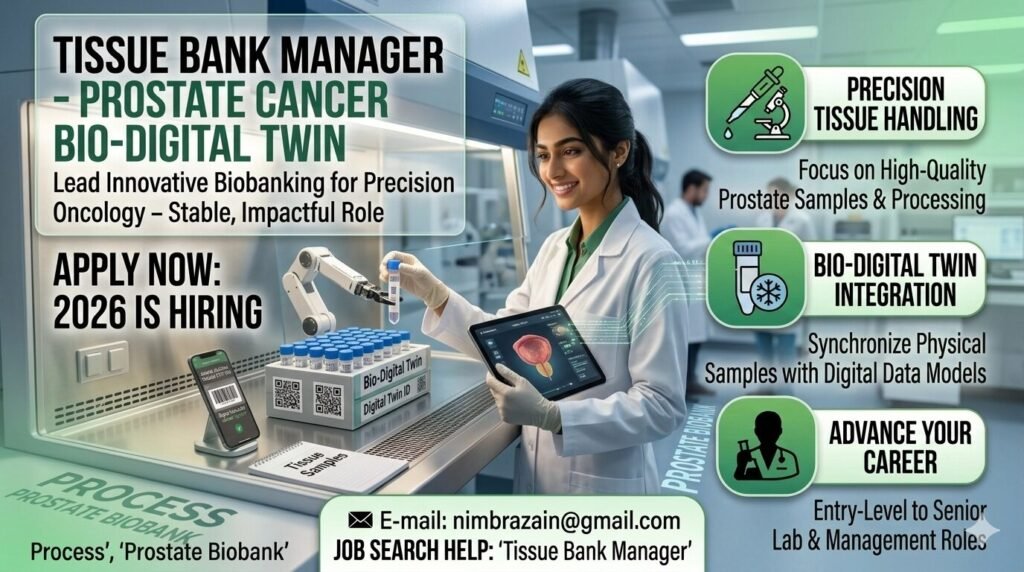
What they’re looking for (the honest version)
You need a bachelor’s degree in biomedical science or something close. But if you’ve got equivalent experience? They might still talk to you. You’ll just have to prove you know your stuff.
You’ve worked in a research tissue bank before. Not a regular lab. Specifically biobanking. There’s a difference.
You know molecular biology techniques. PCR, sequencing – that kind of alphabet soup.
And you’ve managed projects at a senior level. That means you’ve led people, handled budgets, and met deadlines without losing your mind.
Why you might actually want this job
Because it matters. I’m not just saying that.
Prostate cancer ruins families. Millions of them. This project – the Bio-Digital Twin – could change how we screen, diagnose, and treat it. And you’d be right in the middle of it.
Also, it’s Imperial College London. Top ten university in the world. Smart people everywhere. Nine campuses across London. They work on real problems – cancer, climate change, AI, you name it.
The culture? They actually try. Inclusion isn’t just a poster on the wall. Different backgrounds, different industries, different ways of thinking – all welcome. Their values are respect, collaboration, excellence, integrity, innovation. I know that sounds like corporate fluff, but at Imperial? People kinda mean it.
A few things nobody tells you
This is a fixed-term role. So not permanent. But with a project this big? Extensions happen. New funding appears. It’s not a dead end.
It’s full-time. Some weeks will be chill. Some weeks will be chaos. You’ll be based at Charing Cross Campus, but you can work from home sometimes.
Oh, and they might close applications early. If too many people apply, poof – gone. So don’t wait until April 29th. Seriously.
Tech issues with the application? Email support.jobs@imperial.ac.uk. They actually respond.
The bottom line (no fluff)
If you’ve run a biobank before, and you want to do it for a cause that actually saves lives – this is your job.
£46k to £56k. A team that’s growing. A university that backs you. And the chance to be part of something that could change prostate cancer care worldwide.
Apply soon. Like, this week. Don’t overthink it.
| Section | What You’ll Find |
| 1. Okay, so what even is this job? | A plain‑English overview of the Bio‑Digital Twin and the TRANSFORM trial |
| 2. What your days would actually look like | Daily tasks – budgets, compliance, team leadership, researcher support |
| 3. What they’re looking for (the honest version) | Required degree, biobanking experience, molecular bio skills, senior project management |
| 4. Why you might actually want this job | Purpose, Imperial’s reputation, culture and values |
| 5. A few things nobody tells you | Fixed‑term reality, hybrid work, early closing risk, tech support |
| 6. The bottom line (no fluff) | Final push – salary, team, and why you should apply this week |
UK Biobank Is Hiring a Scientific Training Officer (Yes, You Read That Right)
I know. You were looking for biobank director jobs.
But hear me out.
UK Biobank just posted a role that doesn’t come around often. It’s not a Biobank and operator job in the traditional freezer-management sense. But if you’ve worked in biobanking and you actually like teaching people? This might be your dream gig.
Let me explain.
What’s the job
Scientific Training Officer.
Newly created role. UK Biobank. Manchester (initially Stockport, then moving to Manchester Science Park in 2026).
You won’t be fixing freezers at 2 AM. But you will be helping thousands of researchers around the world understand how to use one of the biggest biomedical datasets ever made.
Think of yourself as the translator. The bridge. The person who takes crazy-complex science and turns it into something a researcher can actually use.
What will you actually do?
Here’s the real list. No HR fluff.
You’ll run the Researcher Community portal. Keep it updated. Make sure the training materials aren’t outdated garbage.
You’ll manage the forum. Answer questions. Keep conversations helpful. Stop people from being jerks to each other.
You’ll work with subject matter experts. Drag them away from their labs long enough to explain things in plain English. Then turn their knowledge into training materials.
You’ll make the portal better. Look at user feedback. Run tests. Add features that actually help.
You’ll track everything. How many people use the portal? What are they looking at? What’s working? What’s not?
You’ll be the middleman. Between researchers and internal teams. Between questions and answers. Between confusion and clarity.
Is this you?
They’re looking for someone with:
- An MSc or equivalent in life sciences or clinical field.
- Experience supporting life sciences researchers. Training, outreach, customer-facing – any of those count.
- Experience making or delivering scientific training materials.
- Ability to work across different teams without losing your mind.
- Confidence to talk to researchers and explain complex stuff simply.
- Good organisational skills. You’ll juggle multiple things at once.
The boring but important stuff
- Hours: 35 per week, Monday to Friday. Some flexibility.
- Location: Greater Manchester. 3 days onsite, hybrid available. Occasional travel to Oxford, London, and Imaging Centres.
- Start: Role is live now.
Why this role matters (and why you should care
Most biobanks collect samples. UK Biobank does that too – half a million participants, huge repository.
But here’s what makes them different: they actually care about teaching researchers how to use the data.
That’s rare.
Most places just dump a dataset on you and say “good luck.” UK Biobank is building a whole training programme. And they need someone to run the community side of it.
If you’ve worked in a Biobank and operator role before, you already understand the science. You know what researchers struggle with. You’ve seen the confusion firsthand.
That makes you perfect for this job.
The perks (because we all care about this)
UK Biobank actually treats people well. Shocking, I know.
Here’s what you get from day one:
- 26 days annual leave + bank holidays. Goes up the longer you stay.
- Buy an extra week of leave if you want.
- Paid day off for your birthday.
- USS Pension scheme (hybrid defined benefit/contribution – that’s good).
- Healthcare cash plan. Claim back dentist, physio, etc.
- Enhanced family leave (subject to eligibility).
- Cycle to Work scheme.
- Interest-free season ticket loan.
- Reimbursed professional subscriptions.
- Annual learning budget. Courses, books, whatever helps you grow.
- Free on-site gym.
- Subsidised canteen lunches.
- Free car parking.
- Employee discounts portal.
- Employee Assistance Programme (confidential support).
- Free annual flu jab.
- Life assurance cover.
Not bad for a public sector-ish role.
A few things they didn’t say (but I will)
This is a new role. That means you get to shape it. No one’s telling you “this is how we’ve always done it.” Because there is no “always.” You’re the first.
That’s exciting. And also a little scary. You’ll have to figure some stuff out as you go.
The hybrid setup is nice. Three days onsite, two wherever. But the onsite days are in Manchester. If you don’t live near there, factor that in.
Occasional travel to Oxford and London. Not crazy travel, but you’ll leave your house sometimes.
How to actually get this job
I’ve hired for similar roles. Here’s what will make your application stand out.
Show them you’ve trained people before. Don’t just say “I have experience.” Give an example. “I trained 50 researchers on LIMS software and reduced help desk tickets by 30%.” Numbers work.
Mention your biobank background. If you’ve worked as a Biobank and operator or any biobanking role, say it. That hands-on experience is gold. You understand the data because you’ve handled the actual samples.
Talk about the portal. They want someone who can improve user experience. If you’ve ever used a clunky research portal and thought “I could fix this,” tell them how.
Be human in your cover letter. Don’t copy-paste the job description back at them. Write like you talk. Show some personality.
One last thing
This isn’t a biobank director job. I know that.
But if you’ve been in biobanking for a while and you’re tired of the same old freezer alarms and chain-of-custody paperwork? This could be a really cool change of pace.
You still use your science brain. You still help researchers. You just do it from a keyboard instead of a -80°C room.
The job is live now. UK Biobank is a respected name. And the person who gets this role will help shape how thousands of researchers learn for years to come.
That could be you.
70$k-200$k/hr Biobank Jobs Are Hiring Right Now (April 26)
You’ve probably seen the headlines about lab work paying well over $20 an hour. And yes, those jobs exist.
But here’s something most career blogs won’t tell you: entry-level biobank jobs often start right in the $13–$14/hr range. And right now, in late April, a handful of those roles are actively hiring.
I’m not talking about vague “maybe someday” listings. I mean real positions you can apply for today.
Let me walk you through what these biobank jobs actually look like, why they matter, and how to land one—even if you have zero experience in a lab.
What Exactly Are Biobank Jobs?
A biobank is exactly what it sounds like: a bank for biological samples. Blood, tissue, urine, DNA—you name it.
Biobank jobs involve collecting, processing, storing, and tracking those samples so researchers can use them for studies on cancer, rare diseases, and child health.
Some roles require a PhD. But many entry-level positions just need a high school diploma, a steady hand, and attention to detail.
That’s where the $13–$14/hr roles come in.
Why You Should Care About $13–$14/hr Biobank Jobs (Even If the Pay Seems Low)
Let’s be real. Fourteen dollars an hour isn’t going to make you rich.
But here’s what those biobank jobs will give you:
- A foot in the door of the medical research field
- No crazy physical labor (you’re inside, with AC)
- Consistent hours—often day shifts, Monday through Friday
- Skills you can take to higher-paying lab jobs in 12–18 months
I’ve talked to people who started as sample processors at $13.50 and became lab managers making $30+/hr within three years.
So think of these roles as a launchpad, not a finish line.
A Real-World Example: What a Biobank Manager Does (And Why Entry-Level Matters)
Nemours Children’s Health—a well-respected pediatric system—is currently hiring a Research Lab Manager for their Biobank.
That manager role requires a Bachelor’s degree and five years of experience. It’s not an entry-level job.
But here’s what’s interesting: that manager oversees people who do have entry-level biobank jobs. Specimen processors, lab assistants, inventory techs.
Those are the $70$k-200$k/hr positions.
The manager writes SOPs, manages budgets, and ensures CAP compliance. The entry-level team members label tubes, log samples into the Laboratory Information Management System (BSI), and pack shipments for other sites like Orlando or Jacksonville.
Same mission. Different rungs on the ladder.
5 Proven Tips to Land One of These Biobank Jobs (Starting at $70$k-200$k/hr)
1. Target the Right Job Titles
Don’t just search “biobank jobs.” You’ll miss half the openings.
Instead, look for:
- Specimen Processor
- Lab Assistant – Biorepository
- Sample Management Technician
- Clinical Research Assistant (entry level)
These all pay in the 70$k-200$Krange and involve biobank work.
2. Highlight One “Boring” Skill on Your Resume
Most applicants list “team player” and “hard worker.” That’s fluff.
What biobank hiring managers actually want is attention to detail—but proven.
So write this: *“Logged 150+ samples daily with zero data entry errors over three months.”*
That single line beats any generic adjective.
3. Learn the Lingo Before the Interview
You don’t need a science degree. But you do need to know what SOP, CAP, and LIMS mean.
- SOP = Standard Operating Procedure (the rulebook)
- CAP = College of American Pathologists (the group that inspects biobanks)
- LIMS = Lab Information Management System (the software for tracking samples)
Drop those three terms naturally in your interview, and you’ll sound like you’ve already worked in a biobank.
4. Apply to Children’s Hospitals (Seriously)
Most people flock to adult hospitals or pharma companies.
But children’s hospitals like Nemours often have biobanks that are less competitive because applicants don’t think to look there.
Nemours, for example, serves Delaware, Florida, Pennsylvania, and New Jersey. Their biobank supports pediatric research. And they’re hiring.
Less competition + real openings = better odds for you.
5. Be Ready to Explain Why You Want This Job
Not “I need a paycheck.”
Say something like: “I want to work in a biobank because I’ve seen how delayed sample processing can ruin a study. I’m the person who makes sure that doesn’t happen.”
That’s honest. It’s specific. And it shows you understand the stakes.
What Employees Say About Working at a Place Like Nemours
I looked up real feedback from people who work at Nemours Children’s Health.
Most say they feel treated with respect. They get breaks without someone hovering. And they can choose their shifts.
The downsides? Some say sick days use up paid time off. And a few mention stress during busy periods.
But overall, people stay. That’s a good sign for anyone applying to biobank jobs at similar children’s hospitals.
The Bottom Line (April 26 – Don’t Wait)
These $13–$14/hr biobank jobs won’t stay open for long.
Most entry-level lab roles get filled within two weeks of posting. By mid-May, the April openings will be gone.
So here’s your move:
- Search “specimen processor” or “lab assistant” on Nemours’ career page
- Tailor your resume with one specific detail (no fluff)
- Learn SOP, CAP, and LIMS tonight
- Apply by Wednesday