

You’ve finished training, packed your bags, and you’re ready to take on your first locum tenens assignment. There’s just one problem.
Nobody can pay you until you have a National Provider Identifier.
I’ve watched too many talented clinicians hit this exact wall. The good news? Learning how to apply for an NPI number takes about twenty minutes. And once you have it, that number follows you everywhere—from rural critical access hospitals to busy urban trauma centers.
Let me walk you through exactly what you need.
Apply Also: How to Find Legit NPI Enumerator Remote Jobs (Enumerator Jobs 2026—Apply Now)
What Exactly Is an NPI Number?
Think of your NPI as a social security number for your clinical work. It’s a unique 10-digit identifier issued by the federal government. Unlike state licenses that expire or DEA registrations that need renewal, your NPI stays with you for your entire career.
There are two types:
- Type 1—For individual providers like you. Physicians, nurse practitioners, physician assistants, and other solo practitioners fall here.
- Type 2—For organizations like hospitals, group practices, or billing entities.
As a locum tenens clinician, you need a Type 1 NPI. Full stop.
Apply Also: Public Utilities Specialist Jobs in the USA: Opportunities
Why You Cannot Skip This Step
Here’s what happens without an NPI: nothing. No claims get paid. No prescriptions get processed. No credentialing packets get approved.
Every hospital or clinic where you take a locum tenens assignment will ask for your NPI during credentialing. It’s how they verify who you are, track your services, and bill insurers correctly.
Waiting until you land an assignment to figure out how to apply for an NPI number is a mistake I’ve seen delay starts by weeks. Do it now.
Apply Also: Teacher (Substitute) Job: 7 Proven Tips to Succeed at Fort Campbell, KY
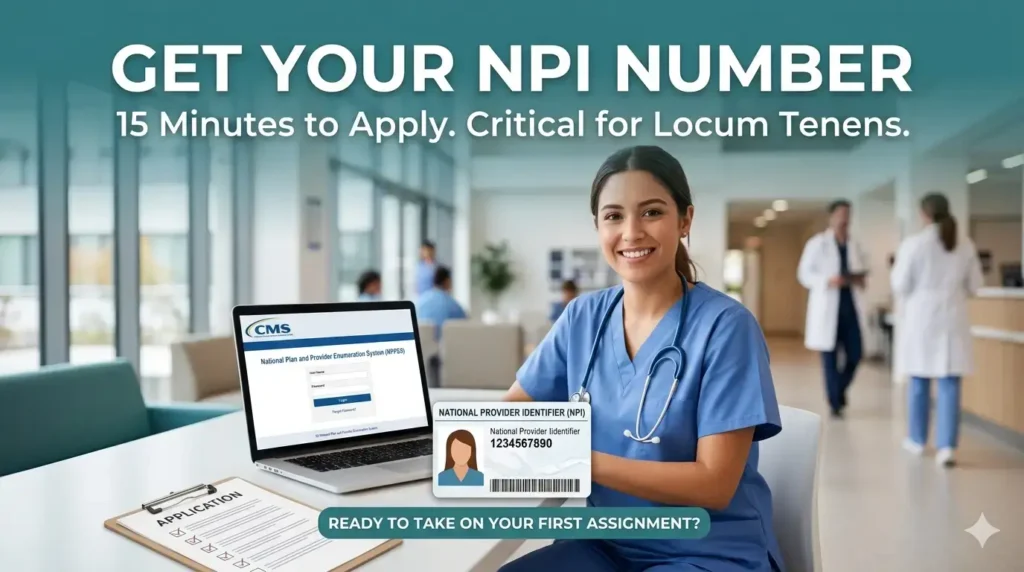
How to Apply for an NPI Number in 5 Simple Steps
Step 1: Gather What You’ll Need
Before opening any browser tabs, grab these items:
- Your Social Security number (or ITIN)
- Personal details (name, date of birth, contact info)
- Practice location and mailing address
- Your taxonomy code (more on this in a second)
- Any existing provider IDs you may have
That’s it. No fees. No complicated paperwork.
Step 2: Choose Your Application Method
You have three options, but only one makes sense for most people.
Online (recommended): Use the National Plan and Provider Enumeration System (NPPES) website. You’ll create a CMS account, fill out the form, and submit it. Most people finish in 15-20 minutes.
By mail: Download Form CMS-10114 and send it to:
NPI Enumerator
7125 Ambassador Rd. Ste 100
Windsor Mill, MD 21244
Through a contractor: An Electronic File Interchange Organization (EFIO) can apply for you, but this is overkill for most individual providers.
Go with the online method. It’s faster, you’ll get confirmation immediately, and you can track your status.
Apply Also: Best Air Traffic Controller Jobs: No Degree? 7 Steps
Step 3: Select Your Taxonomy Code Correctly
This trips people up more than anything else.
A taxonomy code is a 10-character alphanumeric identifier that describes your specialty. Choose the wrong one, and credentialing teams will flag your application.
For example:
- Family Medicine: 207Q00000X
- Internal Medicine: 207R00000X
- Nurse Practitioner: 363L00000X
Check the official CMS taxonomy code list here—bookmark this page.
Step 4: Submit and Wait
After you hit submit, the clock starts ticking.
- Online applications typically receive your NPI within 10 business days
- Paper applications take closer to 20 business days
You’ll receive your number via email from customerservice@npienumerator.com. Add this address to your contacts so it doesn’t land in spam.
Step 5: Verify and Start Using It
Got your number? Great. Now log back into NPPES and double-check every field. One wrong digit in your address or taxonomy code will cause credentialing headaches later.
Once verified, add your NPI to your CV, your credentialing packets, and anywhere else facilities will look for it.
Apply Also: Best 62+ Remote Night Shift Jobs in Pakistan (How to Get Hired by US Companies)
How to Apply for an NPI Number During Residency (Yes, You Can)
Here’s a pro tip I wish someone had given me earlier: apply during residency.
You don’t need to wait until graduation. Residents and even late-stage medical students can and should get their NPI early. Why?
- You’ll need it to write prescriptions and order labs
- Pharmacies and insurers require it for claims processing
- Your NPI follows you forever, so getting it early costs nothing
- Many residency programs expect you to have one for compliance
Apply during your second or third year of residency. Future you will be grateful.
Why Your NPI Number Is Critical for Locum Tenens Jobs
Permanent positions have one credentialing process. Locum tenens? You might go through ten different credentialing processes in a single year.
Each facility checks your NPI record as part of their verification process. They look at your practice locations, your taxonomy, and your contact information. If anything looks off, they flag it. And flags mean delays.
Here’s what happens when your NPI is clean and current: you move through credentialing faster. Faster credentialing means earlier start dates. Earlier start dates mean you start earning sooner.
Learn more about how locum tenens credentialing works
Keeping Your NPI Updated (Most Clinicians Forget This)
You are responsible for keeping your NPI record accurate. Not your agency. Not the hospital. You.
Every time you:
- Get a new state license
- Change your practice address
- Complete a residency or fellowship
- Add a new specialty
Log into NPPES and update your record.
For permanent staff physicians, this might mean updating once every few years. For locum tenens clinicians juggling multiple state licenses and facilities? You should check your record every time you start a new assignment.
When you partner with a locum tenens agency like Medicus, our credentialing team can help flag when updates are needed. But the actual update? That’s on you.
See our full guide to locum tenens licensing requirements
A Note on NPI Privacy and Security
Your NPI is public information. Anyone can search the NPI registry and find your name, specialty, and practice addresses.
This is by design. Hospitals, insurers, and billing companies need to verify providers easily. Just be aware that your information is out there, and act accordingly.
Ready to Start Your Locum Tenens Journey?
Getting your NPI is the easy part. Fifteen minutes of paperwork, ten days of waiting, and you’re done.
The harder part? Finding assignments that match your skills, schedule, and preferred locations. That’s where we come in.
At Medicus, we’ve helped thousands of clinicians navigate everything from first-time NPI applications to multi-state credentialing. Our recruiters know which facilities move fast and which ones need extra hand-holding.
Your next step: Secure your NPI if you haven’t already. Then browse our open locum tenens jobs or fill out the form below to connect with a recruiter who can walk you through the rest.
Enumerator phone/field at the National State
Join NASDA as a Part-Time Field Enumerator – $17.75/hr + Mileage
First, the pay: $17.75 per hour plus mileage reimbursement.
Second, the flexibility: You set your own hours. Evenings, weekends, holidays — you decide.
Third, you can work from home (except when you’re driving to a field).
And honestly? You’ll learn where your food actually comes from. That’s pretty cool.
If that sounds good, keep reading.
Who Is NASDA Anyway?
We’re a nonprofit. No political drama. We’ve been around since 1916.
We represent agriculture leaders from all 50 states and four U.S. territories. Our job is to help American farming grow through good policies and real partnerships.
Since 1972, we’ve been sending people like you to collect data for the USDA. We need folks who care about farming — or at least want a steady, meaningful part-time job.
A Day in the Life of a Field Enumerator
Every day is different.
One morning you’re interviewing a farmer over the phone. The next, you’re driving to a field to count crops. You’ll also talk to ranchers and other ag businesses.
What You Need to Bring
You don’t need a degree. But you do need:
- Ability to multitask in a fast, deadline-driven environment
- A friendly, professional attitude (you represent us)
- Willingness to count crops in fields (yes, outside)
- A reliable personal vehicle
- Good phone and in-person conversation skills
- Basic computer or iPad knowledge
Also: good communication, time management, self-motivation, teamwork, organization, and a positive attitude.
If that sounds like you — great.
Schedule & Hours
Part-time. Super flexible.
Some evenings. Some weekends. Some holidays. Depends on weather, farming seasons, and local events.
Ready to Apply? It Takes 3 Minutes
We keep it simple. No long forms. No stupid tests.
Just fill out our mobile-friendly application. Three minutes. That’s it.
A Few More Things
You’ll need to pass a background check. Standard stuff.
NASDA does not discriminate based on race, color, national origin, sex, religion, disability, political beliefs, or family status. Everyone is welcome.
Apply Now
If you want a flexible, part-time job that actually matters—and pays $17.75 an hour plus mileage—hit the apply button.
We’d love to meet you.