
You’ve seen the towers. You’ve watched the planes line up. And maybe you’ve thought, “That’s the job for me.” Then came the gut punch—everyone says you need a four-year degree.
Here’s the truth: Air Traffic Controller jobs don’t always require that expensive piece of paper.
I’ve talked to controllers who started right out of high school. A degree helps some people. But it’s not the only door. Not even close.
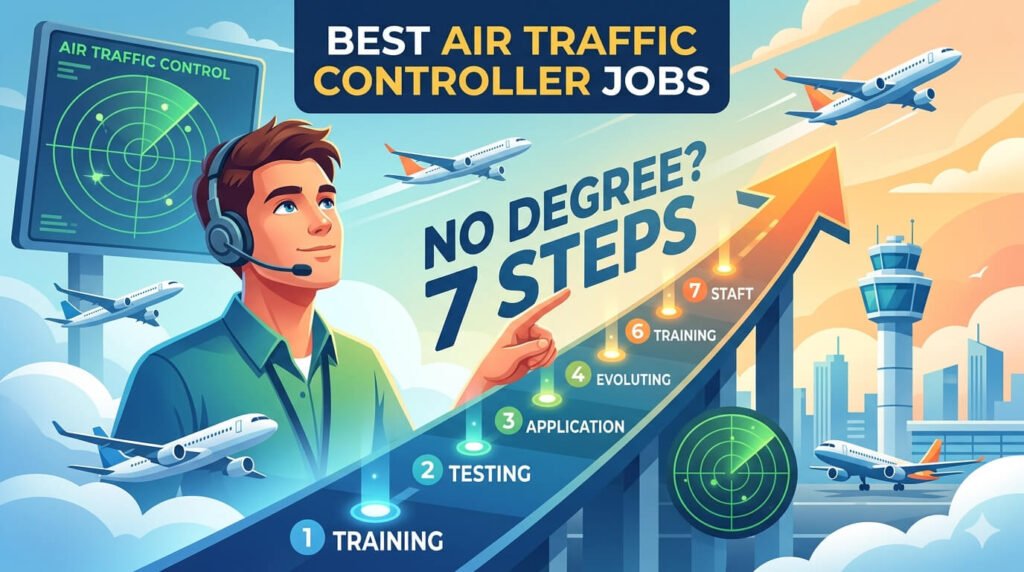
Below are seven proven steps to land one of those Air Traffic Controller jobs without spending a dime on tuition. No fluff. Just real, human advice.
Alternative Job:Best 62+ Remote Night Shift Jobs in Pakistan (How to Get Hired by US Companies)
Step 1: Understand Which Pathways Actually Work
You can’t just walk into an FAA facility and ask for a headset. The agency has three official routes. Two don’t require a bachelor’s degree.
The first is the CTI program—Collegiate Training Initiative. You don’t have to finish the degree to apply. You just need certain coursework. Many CTI graduates get hired without graduating.
The second is OTS—Off the Street. This is the golden ticket. The FAA opens applications to the public for a few weeks each year. No degree needed. No prior experience. Just U.S. citizenship, under 31 years old, and passing a few aptitude tests.
The third is military experience. Veterans get preferential hiring.
So if someone says, “You need a degree for Air Traffic Controller jobs,” they’re wrong. Plain and simple.
Alternative Job:Best 9 High Paying Jobs Without a Degree in 2026 – Earn Up to $124K
Step 2: Crush the AT-SA Exam
The Air Traffic Selection and Training assessment is the real gatekeeper. Not your GPA. Not your resume.
This test measures logic, spatial awareness, and how fast you process multiple data streams. It’s brutal. But it’s learnable.
I’ve seen people with master’s degrees fail. And 19-year-olds who worked at a pizza shop passed. Why? Because they practiced.
There are free and paid simulators online. Spend ten hours on those before you apply. That’s worth more than four years of college when it comes to Air Traffic Controller jobs.
The FAA doesn’t care if you can write a poetry analysis. They care if you can keep three imaginary planes from crashing.
Step 3: Get Your Age and Citizenship Right
This part stings. You have to be under 31 years old when you apply for most Air Traffic Controller jobs. The FAA forces mandatory retirement at 56, so they need time to train you.
If you’re 32? Sorry. That door is closed unless you have prior military ATC experience.
Also, you need to be a U.S. citizen. No green cards. No work visas. It’s national security.
So if you’re 28 and reading this? Stop waiting. The clock is ticking.
Step 4: Pass the Medical and Security Clearance
You’ll need a second-class FAA medical certificate. Good vision (20/20 with or without glasses), decent hearing, and no conditions that cause sudden incapacitation.
Here’s where people mess up: they lie about past drug use or mental health treatment. Don’t do that. The FAA will find out. They do deep background checks for Air Traffic Controller jobs. A single lie can ban you for life.
I’m not saying you need to be perfect. I’m saying you need to be honest. The agency has waivers for old mistakes. They have no waivers for liars.
Step 5: Apply During the Open Window
The FAA doesn’t hire year-round. They open applications for Air Traffic Controller jobs for about one to two weeks, once or twice a year. Miss that window? You wait another 12 months.
Follow the FAA’s social media accounts. Sign up for email alerts on USAJOBS. Set a calendar reminder.
When the announcement drops, apply immediately. Not on the last day. I’ve watched qualified people lose their shot because they waited until Friday.
Step 6: Survive the Academy
Let’s say you get hired. Congratulations. Now the real work begins.
You’ll go to the FAA Academy in Oklahoma City for two to five months. They pay you during training. A salary while you learn. But don’t get comfortable.
The pass rate hovers around 70–80%. You’ll study phrases like “taxi to runway two-seven via alpha, bravo.” You’ll run simulated radar scenarios until your eyes burn.
People without degrees succeed here all the time. Why? Because the academy doesn’t test book smarts. It tests recall, composure under pressure, and following rigid procedures. You can build those skills whether you went to Harvard or never stepped foot in a college classroom.
Step 7: Choose Your Facility Wisely
After the academy, you get assigned to an ATC facility. Tower. Tracon. Center. Each has a different difficulty level and cost of living.
Here’s a secret: you can trade assignments with other new hires. The FAA allows facility swaps. So if you get placed in a high-cost city like San Francisco, find someone heading to a cheaper location and swap.
Also, smaller towers are easier to learn in. You’ll handle fewer planes, build confidence, then transfer to a busier facility after a year or two.
This matters because Air Traffic Controller jobs have a steep learning curve. Don’t let pride push you into a Level 12 facility on day one. You’ll wash out.
What About the People Who Say a Degree Helps?
Let’s be fair. A degree does help some people. If you have one, you qualify through the CTI pathway, which sometimes gives a slight edge.
But “helps” isn’t “requires.” And paying $40,000 for a degree you don’t need? That’s financial poison.
The average starting salary for an FAA controller is around $40,000–$50,000 during training, jumping to over $80,000 after certification. At busy facilities, experienced controllers clear $150,000.
Now imagine graduating with student loan payments. Now imagine graduating debt-free because you skipped the degree. Who’s better off?
You do the math.
A Word on Military Experience
If you’re already in the military or considering it, the ATC career field is wide open. The Air Force and Navy train their own controllers. Those skills transfer directly to civilian Air Traffic Controller jobs—often with higher starting pay and no age limit.
But don’t enlist just for ATC. That’s a six-year commitment. The military is great for some. For others, it’s a detour.
Know your own situation.
The Hard Truth
Not everyone gets these jobs. The FAA receives tens of thousands of applications for a few hundred Air Traffic Controller jobs each year. You will face rejection. Maybe more than once.
But here’s what separates those who make it: persistence.
I’ve met controllers who applied five times. Six times. They failed the AT-SA twice before passing. They kept showing up.
A degree wouldn’t have helped them. Grit did.
So stop researching. Stop asking “what if.” Go practice for the AT-SA right now. Set your USAJOBS alert today. And when that application window opens, you jump on it.
Because your future depends on it.